Rich Tech Bros don’t need Free Cities

One of the most aggressive arguments put forward by opponents of Free Cities is that they are merely for rich American "tech bros" who want to avoid paying taxes and wield unlimited power. All other people would either be unwelcome or effectively slaves in Free Cities. Guess what? - Rich people do not need Free Cities to pay no taxes, to be above the law, to influence political decisions and to treat people like slaves. (Of course, it is impossible to avoid ALL taxes. Nobody can avoid VAT. But when people talk about tax avoidance, the tax referred to is usually income tax.) Avoiding taxes is incredibly easy in most countries. Even in a system as dreadfully statist and collectivist as the Federal Republic of Germany, it is easy to avoid paying income tax - and this applies to nearly everyone, whether you are a super-rich individual or a poor "wagecucks" earning minimum wage. Simply file a proper annual tax return, and it is no feat of magic to pay virtually no income tax. You don't even have to cheat; even with 100% honesty, it is possible to get back all, or at least the vast majority, of the income tax you have paid.
However, most people are simply too lazy or too comfortable to file an income tax return. (This is not legal, financial or tax advice. It is purely a polemical, evidence-based personal account of a poor wagecuck. Just try it out for yourself.) However, even if you live in a country where tax laws do not provide for such arrangements, it is still possible to avoid taxes legally, though this is naturally an option primarily for the wealthy (who have absolutely no need for a Free City to do so). By acquiring additional citizenships (such as through "citizenship by investment") and making a smart choice regarding one's primary residence (for instance, in Panama), avoiding taxes is not a problem at all.
And effectively standing above the law? No problem for the wealthy. There is absolutely no need for a "Free City" for that. It is not at all difficult for a rich person to buy diplomatic status. There are brokers who specialize in brokering diplomatic posts. Consul Hans-Hermann Weyer-Graf von Yorck (1938-2023), also known as "the handsome Consul", was a prominent, indeed legendary, example of such a title dealer.
Another piece of evidence is the 2011 Danish documentary movie ‘‘The Ambassador‘‘.In this cinematic masterpiece, Danish filmmaker Mads Brügger purchases the position of diplomat for the Republic of Liberia in the Central African Republic, facilitated by a specialized broker, for a six-figure sum. A genuine master’s degree from a real Liberian university was thrown in as a bonus with the diplomatic post. Naturally, after all, one wants to get something solid for one's money. Brügger exposed how diplomats are involved in criminal activities, such as diamond smuggling, and are effectively untouchable due to their diplomatic status; indeed, they stand above the law. So, if a rich person buys themselves a diplomatic post - or better yet, two or three - who can possibly touch them legally? Diplomatic status provides protection against legal prosecution.
Political influence by the wealthy? That’s a good one. That is precisely what wealthy people are already doing, even in those oh-so-democratic so-called welfare states. And practically everywhere, too. Of course, overt corruption is illegal. But there are subtler ways to exert influence: donations to political parties and politicians, lucrative seats on supervisory boards of their companies for government politicians, and so on. Or they simply become politicians themselves. After all, there are plenty of examples of wealthy entrepreneurs who successfully built a party using their own wealth and made it into government, such as Prime Minister Silvio Berlusconi (1936-2023) in Italy, Prime Minister Andrej Babiš in the Czech Republic, Prime Minister Thaksin Shinawatra in Thailand or President Donald J. Trump in the USA.
Rich people do not need a Free City to exercise power. The conventional nation-state is perfectly adequate for that purpose. And the fact that human beings are at the mercy of others, treated practically like slaves, even though slavery officially no longer exists (except in the Islamic Emirate of Afghanistan, where the Taliban officially reintroduced the legal status of slavery in early 2026), is a reality. And this in "strong states"! It is total BS to claim that there will be masters and slaves in Free Cities. What nonsense. Countless people around the world are living in de facto slavery. And this despite living in traditional nation-states where slavery officially does not exist at all (except in Afghanistan, where slavery has officially returned). There are so many examples of people who are practically slaves with no rights whatsoever: victims of forced prostitution, psychiatric patients, forced laborers, domestic workers, low-wage workers, kidnapping victims, and so on and so forth.
Most existing nation-states fail to prevent modern forms of slavery. Or they do not truly want to. The equality of all people remains a dream. A promise that has so far gone unfulfilled. A Free City would be far more resilient against modern forms of slavery than traditional nation-states.
Why? Because in a Free City, equality before the law is guaranteed. There is no way for the Free City’s operator to arbitrarily change rules or strip residents of their rights. Disputes between the operator and residents are resolved by neutral arbitration tribunals. In a Free City, the operator focuses on what should be the core task of a state: protecting people’s lives, physical integrity, and liberty from violence and oppression. So that the law of the strongest does NOT prevail. So that nobody can have their rights infringed upon by others. So that nobody ends up in a helpless, vulnerable, slave-like position. Ordinary people from the middle and lower classes benefit most from this. Wealthy people have their own methods of protecting themselves. Some were mentioned in this text. Poor people do not have these options.
So, who actually lives e.g. in Próspera ZEDE, the world’s first modern, privately organized Free City? It is not the super-rich. Instead, the residents are primarily young, creative startup entrepreneurs. People who want to build something new but face excessive bureaucratic hurdles in their home countries. People who sought a place where they could breathe freely and unfold their potential.
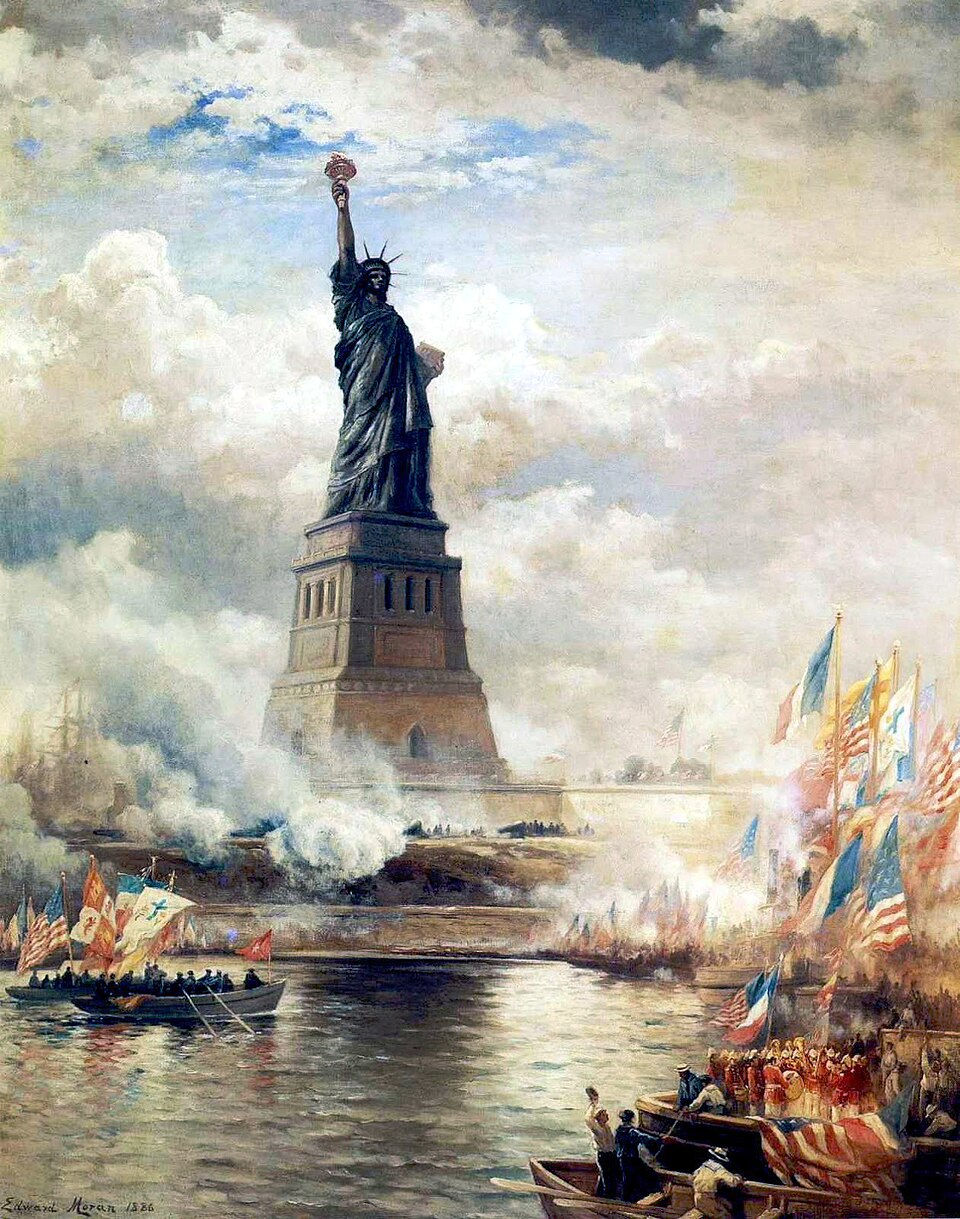
A Free City guarantees liberty and equality before the law. Without liberty, there is no equality. A historical example powerfully supports this perspective: the Statue of Liberty. The Statue of Liberty was made possible through donations. And who ultimately made the erection of the Statue of Liberty possible? Who donated the final 100,000 US dollars, without which the statue’s pedestal could not have been built, and indeed, without which the finished statue by French-Alsatian sculptor and painter Frédéric Auguste Bartholdi might well have ended up in the scrap heap? Was it the wealthy? Was it the Astors, Carnegies, Rockefellers, Vanderbilts, or the other monopolists, known at the time as "Robber Barons", who could have easily covered the sum out of their petty cash?
NO! For the wealthy do not need liberty guaranteed by law. Rich people can litteraly buy this liberty for themselves and defend it with their resources. Some of their methods were discussed in this text.
The Statue of Liberty in New York City was ultimately made possible by the selfless donations of thousands upon thousands of working-class and lower-middle-class New Yorkers. Responding to a fundraising appeal by journalist and publisher Joseph Pulitzer—who was born a citizen of the Austrian Empire and had emigrated to the U.S. at the age of seventeen, impoverished New Yorkers gave their savings. Some even went hungry, to make their contribution to the cause. For they all wanted to see the Statue of Liberty. The wealthy were indifferent to the Statue of Liberty; indeed, they may even have found it unsettling. The poor, however, desperately wanted the Statue of Liberty. Mind you - the Statue of Liberty. Not the Statue of Equality, not the Statue of Justice. No, the Statue of Liberty. Or, as Lady Liberty is actually named: ‘‘Liberty Enlightening the World‘‘. It was the promise of Liberty that gave expression to the deepest hopes of New York City's poor population.
The poem ‘‘The New Colossus‘‘ by Emma Lazarus (1849-1887), which is inscribed on a bronze plaque in the Statue of Liberty, states, among other things:
„Keep, ancient lands, your storied pomp!“ cries she
With silent lips. „Give me your tired, your poor,
Your huddled masses yearning to breathe free,
The wretched refuse of your teeming shore.
Send these, the homeless, tempest-tossed to me:
I lift my lamp beside the golden door.“
The fact that liberty is, above all, a promise, a source of hope for the poor, could not be expressed more beautifully than in this poem.
Every Free City should adopt as its moral and spiritual foundation the promise that the Statue of Liberty proclaims to the poor and oppressed of the world.
However, critics of the Free Cities argue that the Free Cities movement is funded by people like Peter Thiel. Therefore, they claim, Free Cities must be a tool of the rich American "tech bros." Well, for one thing, that is simply factually incorrect. The Free Cities movement is decentralized; there is no single financier or big boss. There are even projects that have no investors at all (yet). Yes, wealthy individuals do invest in specific Free Cities projects, people who certainly wouldn't need Free Cities themselves to live completely free and self-determined lives. Why? Quite simply: Because rich people invest. Investors invest. That is their ‘‘job‘‘. That is how they generate new revenue streams. That's how venture capitalists make more and more money.
By looking around for promising projects and investing in them, regardless of the industry. That has nothing specifically to do with Free Cities. Rich investors invest wherever there is potential for good profits. EVERYWHERE. And given the simple fact that small political entities function better than large ones, Free Cities are highly promising in every respect—including economically. Consider the extraordinary economic rise of special economic zones and city-states, which often transformed from small fishing villages into vibrant financial and economic metropolises within just a few decades.
Places like Shenzhen or Dubai offer a glimpse of the immense potential that Free Cities could hold, even from a purely economic perspective.
It therefore makes sense for rich investors to invest in things like this, just as they invest in promising tech startups, for example. The irony is that even those who condemn Free Cities almost certainly consume products and services themselves that are backed by the money of rich American tech bros. What a hypocrisy!
If you don’t want to support anything backed by the money of wealthy (American) tech bros, who, in many countries, have effectively achieved monopolies despite all the democratic oversight and government-guaranteed social justice, then please consider moving to an Ecovillage. For example, to the Free City of Panagua. Courageous pioneers are always welcome.