The Austrian Flag in Shanghai

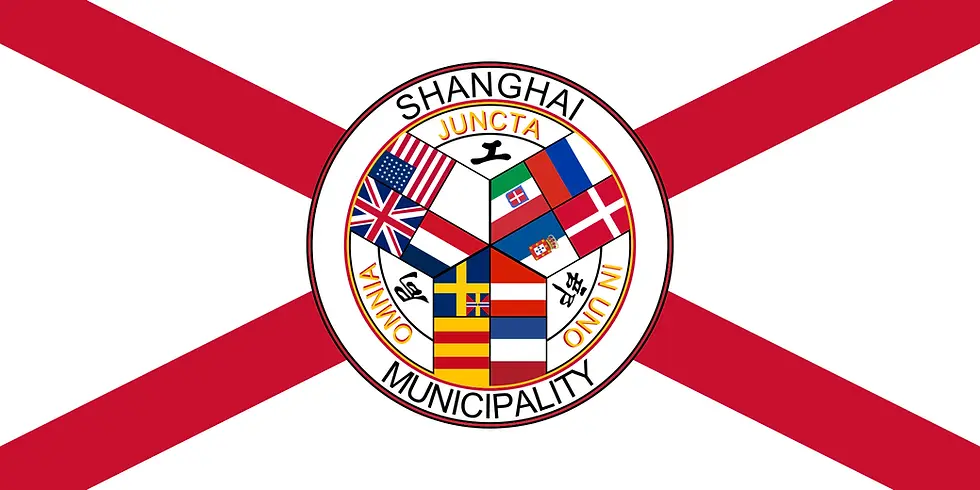
From 1863 to 1943, a large part of the Chinese metropolis of Shanghai was an international free city. Nineteen nations had joined forces to administer a cosmopolitan, autonomous city-state. In the wake of World War I, Germany and Austria-Hungary were excluded from this unique political arrangement. The section of the coat of arms and flag symbolizing Germany was removed, leaving a blank white space in its place. Austria’s emblem, however, was not removed from the coat of arms or the flag. Partly because it would not have looked visually appealing, and partly because no one really held a grudge against Austria.
After all, why hold a grudge against Austria? From the time of their accession to the throne in 1916, Emperor Karl I (1887-1922) and Empress Zita (1892-1989) had sincerely striven for peace ("Sixtus Affair"). Moreover, it soon became clear to most of the Allies that the complete dissolution of Austria-Hungary had created more problems than it had solved. Consequently, the Austrian flag was retained in the coat of arms and flag of the Shanghai International Settlement. This resulted in a unique situation between 1938 and the final dissolution of the Shanghai International Settlement in 1943: Although there was no independent Austria during this period, with Germany having annexed the country in 1938, the Austrian flag nevertheless remained part of the official city symbols of the Shanghai International Settlement. The Shanghai International Settlement was governed by an elected city council, the Shanghai Municipal Council, whose Chairman effectively held the position of a Lord Mayor of Shanghai.
The establishment of the Shanghai International Settlement was made possible by the Taiping Rebellion (1851-1864), which had severely weakened the Chinese Empire of that era. After repeatedly failing the imperial civil service examinations, thereby shattering his dream of a financially secure and comfortable career as a bureaucrat, Hong Xiuquan (1814-1864) came to believe that he was the younger brother of Jesus Christ and held a divine mandate to liberate China from Qing Dynasty rule. He and his fellow Taiping revolutionaries very nearly succeeded in conquering all of China. Ultimately, however, the rebellion failed due to internal conflicts and the opposition of colonial powers, who had little interest in seeing the emergence of a strong, revolutionary, and religiously socialist China. Nevertheless, the revolutionary spirit of the Taiping Rebellion later inspired both the Kuomintang and the Communist Party of China.
Due to its special status as an international "free city," Shanghai was also one of the few places in the world open to Jewish refugees fleeing areas under German control. The Shanghai International Settlement ceased to exist in 1943 because Japan, an ally of Germany, was at war with several of the nations that maintained the settlement. This was the case even though allies and friends of the Axis powers were also involved in the Shanghai International Settlement; Mussolini’s Italy and Franco’s Spain are notable examples. Denmark, too, had become a member of the Anti-Comintern Pact in 1941, albeit under massive German pressure and was thus de jure allied with Japan. Nevertheless, in 1943, Japan dissolved the Shanghai International Settlement and handed it over to the Reorganized National Government of the Republic of China.
The Reorganized National Government of the Republic of China was a pro-Japanese puppet regime led by Wang Jingwei (1883-1944), the former leader of the left wing of the Chinese Nationalist Party (Kuomintang). After the Allies defeated the Axis powers, with the notable exception of Indonesia, where the Republic of Indonesia (established under Japanese auspices) successfully asserted itself militarily against the Netherlands and the British Empire, the Shanghai International Settlement was not restored. The Shanghai International Settlement had its negative aspects - colonialism and the like, of course.
Yet, it also had its positive aspects. Shanghai exerted a major influence on China’s political, economic, and social modernization. The Kuomintang and the Communist Party of China were generally able to develop there relatively undisturbed. Shanghai offered a safe haven to many people who would otherwise have been murdered in the Holocaust. Furthermore, the Shanghai International Settlement provided practical proof that it is possible for people from diverse countries, cultures, and religions to coexist in an international Free City. In doing so, the Shanghai International Settlement gained valuable experience that could offer instructive lessons for European integration, the United Nations, modern Free City projects, and even Panagua. Without relinquishing their own national identities, the residents of the Shanghai International Settlement also shared a strong local identity as "Shanghailanders." The official motto of the Shanghai International Settlement was (in Latin) ‘‘Omnia Juncta in Uno‘‘, means "All Joined into One." This could for example also serve as a powerful future motto for the United Nations.