An unlikely Galician Friendship

We are living in polarized times. Even in countries with centuries-old democratic traditions, a civilized, respectful, peaceful and constructive dialogue is becoming more and more the rare exception than the norm. Many people, when the hear about the other side of the political spectrum, get in an almost psychotical condition. Blood pressure goes up, heart beats like a steam hammer, facial expression shifts into an angry, pinched grimace and the voice becomes aggressive. Friendships and families are falling apart over socio-political issues and party-political preferences.
But the world is not only black and white. After all, we are all human beings. World history, too, has proven time and again that simplistic, tribalistic black-and-white thinking makes no sense and represents an artificial denial of the multifaceted nature of life. As a practical example, let us consider just one of the most unusual diplomatic partnerships of the 20th century: the one between Fidel Castro’s revolutionary communist Cuba and General Franco’s Spain, widely characterized as fascist and reactionary.
How is that possible? Franco was a staunch nationalist and anti-communist. Even in his very last public speech in October 1975, only few weeks before he died, Anti-Communism was Franco's central message. And yet he supported Fidel Castro and Che Guevara - timeless icons of the political left?
There were several reasons for Franco's sympathy towards Fidel. Both were ethically Galicians. Galicia is a region in northwest Spain. The regional language there is even closer to Portuguese than to Spanish. Then the social background. Franco's regime was elitist and anti-proletarian. Indeed Fidel and his comrades were almost all "rich kids" or at least from upper-middle class background and well-educared. Batista on the contrary was a "poor kid", who had ruthlessly persuaded the goal of becoming rich and powerful at any costs. No matter if by playing the progressive General in alliance with the Communists or by making friends with American Gangsters and effectively transforming the Republic of Cuba into a joint-venture of himself and different American Mobster Bosses like Meyer Lansky and Lucky Luciano. Franco despised Batista both on a personal and political level.
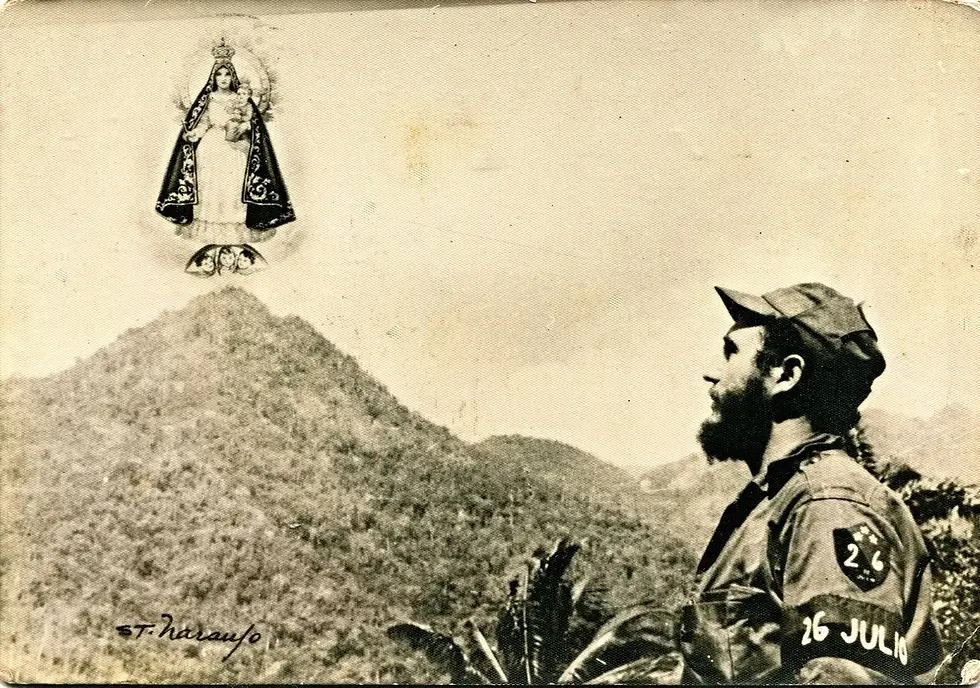
From 1953 on, Fidel Castro and his friends had fought a revolution against the regime of General Batista. Batista was a strange figure. From 1940 to 1944, he was the democratically legitimized President of Cuba in a coalition Government with the Communists. His first Presidency was progressive and improved the lives of the Cuban People. His second presidency from 1952 to 1959 was an ultra-capitalist military dictatorship backed by American Gangster Syndicates.
Castro was first a member of the social-liberal anti-corruption "Orthodox Party". When that party was outlawed by Batista, he launched a revolution. Who supported Fidel Castro and his friends? The Soviet Union, Mexico, Yugoslavia, Communist China and Spain. The Spanish Embassy in Havanna saved many of Castro's comrades by usibg diplonatic pressure and helping them to get out of the country. Indeed some heroes of the Cuban Revolution owe their lives to General Franco.
And Franco recognized that Fidel was a patriot who wanted the best for Cuba, while Batista sold Cuba out to the American Mafia. Besides that both Franco and Fidel liked stylish uniforms, while Batista, despite being a General, rather preferred to dress like a typical American Gangster. And last but bot least Fidel had come to power using Guerrilla tactics and Franco considered Guerilla warfare to be a 100% Spanish thing. That's half-true. Modern Guerilla warfare was indeed invented by Spanish revels who fought against French occupation during the Napoleonic wars. But around 100 years before, pro-Danish insurgents in Southern Sweden had also used similar tactics.
Unlike Mexico, Cuba under Fidel Castro did not recognize the government-in-exile of the Spanish Republic. When the Cuban Revolution was victorious, Cuban expats in Spain celebrated in public. The Spanish Police of the right-wing Franco Regime did nothing to stop these public celebrations of a victorius left-wing revolution. And one of the first economic deals of Cuba's revolutionary Government was made with Franco's Spain. On his way to Cairo, Che Guevara stopped in Madrid to sign the tradd deal. Che Guevara wanted to see a real Spanish bull fight and was allowed to do so by Franco. While discovering Madrid and watching the bullfight, Che was wearing his iconic Guerilla uniform. This is even more remarkable as Che never made a secret out of his Communist beliefs.
Fidel Castro's government quickly transformed Cuba's economic system from Gangster Capitalism to a Socialist Economy. Franco had no problem with that. He respected that Fidel Castro did not spare his own family's wealth, which cemented Castro's reputation as a man of honour, as someone who does not preach water and drinks wine, but as someone who was willing to offer personal sacrifices help his people to get out of mass poverty.
Franco had despised the proletarian grassroot revolutiinary approach of the left-wing People's Front in the Spanish Republic. But he had no problem with a benevolent dictator from the upper class who decrees anti-capitalist reforms from above. Under Franco, Spain itself had a period of third-way anti-capitalist semi-planned and syndicalist economy, which changed in the 1960s, when the Catholic Organization "Opus Dei" became influential in the Spanish Government and pushed for neoliberal capitalist reforms.
Even when Cuba became part of the Soviet Union's sphere of influence, Cuba and Spain maintained friendly and cooperative relations. Only at one occasion in 1960, Fidel Castro accused Spain in a live TV-Show to support the counterrevolution. The Spanish Ambassador in Havanna watched this and was upset. Although he was weak as he had undergone medical surgery and had to rest to recover, he jumped up and right into his car and drove as fast as possible to the TV station. He rushed into the studio, surprising Castro and all others present. Bouncers were not able to hold him back. Live on TV, the Ambassador loudly denied the accusations. Castro and his guests eventually throw the Ambassador out and he even had to go back to Spain. But Franco's reaction surprised Castro. Franco made it very clear that he did not want to break the good relations with Spain. Castro realized like "Wow, fellow Galician bro in Madrid REALLY likes me." and from then on, the relation between the Castro Regime and the Franco Regime were always very good, no matter how much the Americans tried to pressure Franco to end that friendship. Castro never did anything to harm the Franco Regime and Franco never did anything to harm the Castro Regime.
Spain, as the only Western country, even ignored the American Embargo against Cuba. One could even consider Spain to be Cuba's most important ally during the Cold War. At least until Frsnco's death. Because unlike the Soviet Union, Spain was able to ignore the American Blockade without risking a War. Indeed Spanish merchant vessels were attacked by the Americans and Washington D.C. tried to blame Cuba for the attacks. Franco knew that was comple BS, made that clear to the American Government and demanded compensation payments.
Franco was a far-right tyrant. Fidel Castro was a Communist dictator who abandonded the social-liberal democratic values of his early political engagement in the Orthodox Party in favour of an authoritarian rule. Nonetheless the Cuban Revolution improved the lives of many Cubans. Both the Cuban healthcare and education system are excellent.
And the Franco Regime in the end was at least pragmatic enough to enable a peaceful, gradual transition towards Democracy, Parliamentary Monarchy, Federalism and Membership in the European Union. The death of Franco in November 1975 and the following end of the far-right dictatorship in Spain with a transitional period until the first Royal Socialist Government in 1982, did not further improve the relations between the USA. Rather the opposite happened, as Spain now joined NATO. So even with the Socialist Worker's Party of Spain in Government, such fraternal relations with Cuba as were there in under the Regime of the Falange Española Tradicionalista y de las Juntas de Ofensiva Nacional Sindicalista.
When Franco died, Cuba declared 3 days of official mourning. It was supposed to be kept relatively discrete, rather as a friendly gesture towards Spain. By misubderstanding, it was nonetheless published and became known all over the world. Fidel Castro later said, that he was convinced, that Franco's positive relations with him, were not motivated economically, but emotionally, because Franco had seen the Cuban Revolution as some kind of Hispanic revenge against the USA, which had defeated Spain in the War of 1898.
Again, this is neither to say that the right-wing Falangist Franco Regime was good, nor to say that the left-wing Communist Castro Regime was good. This is not the question of this essay. The essential point is that the Spanish-Cuban Friendship during the Cold War is an impressing proof that both friendship and enmity are no automatisms. There is no such thing as inevitable escalation in global politics. Those who seek hostility and confrontation will find arguments to support them. But those who seek peace, friendship and cooperation will also find arguments for it, no matter how great the ideological differences might be.